Are Prediction Markets Legal?

Legal Carve-Up of Prediction Markets is Inevitable: Here is What the Future Holds
The CFTC is losing its grip on the regulation of prediction markets, and the knock-on effects will affect every user.
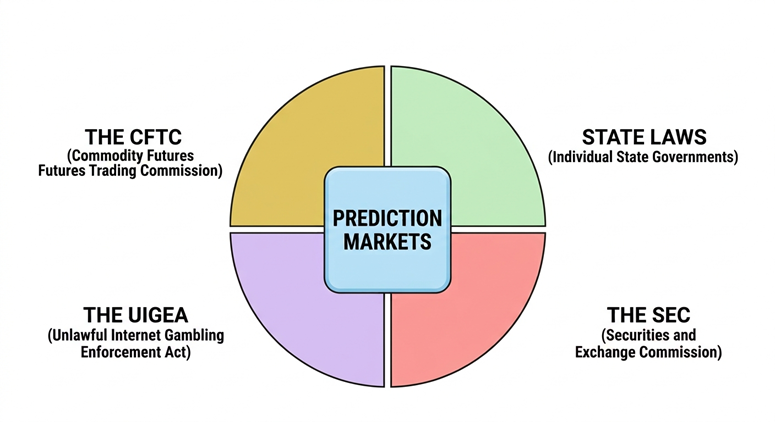
States are asserting their jurisdiction, especially when it comes to sports-related prediction market contracts. Sixteen of them are pursuing legal action. This fight will inevitably end up at the Supreme Court. In parallel, the SEC is becoming more assertive in its claim that it controls markets which are based on the movement of underlying securities.
With the Wire Act, UIGEA and even Frank-Dodd being openly discussed as having jurisdiction over Polymarket, Kalshi and others, it’s clear that there are many more legal and regulatory hurdles ahead.
This page covers the complex legal roadmap for Prediction Market sites and lays out three possible futures for them.
The CFTC Controls Prediction Market Site Licensing: But for How Long?
The Federal Commodities Futures Trading Commission (CFTC) polices derivatives, futures and swaps.
Currently, this agency also licenses prediction markets.
Their remit is to ensure that commodities markets are fair. This includes preventing fraud and other forms of market manipulation. The CFTC were given jurisdiction over events contracts in the Frank-Dodd Act of 2010. They police, license and regulate Prediction Markets.
In 2020 they licensed Kalshi, with the US version of Polymarket receiving a license in 2025.
Other licenses have been awarded to Gemini, DraftKings, Interactive Brokers, Crypto.com and PredictIT. Many of these use the names of holding companies for their technology and licensing activity. Robinhood is separately licensed as a FCM (Futures Commission Merchant) via the CTFC. Its role is as an intermediary, allowing access to the established licensed prediction markets to its users.
How Regulation Works for Prediction Markets
The CFTC has primary responsibility for customer protection, market fairness and financial integrity.
There are rules that state what prediction markets are allowed. This covers topics which are contrary to the public interest, or against Federal law. Assassinations, war or terrorism are explicitly banned.
Fraud, manipulation and insider trading are monitored by the prediction market platforms. The CTFC oversees this data and are active in using its own surveillance (or formally investigating) where required. Fines and disciplinary action are the primary enforcement methods.
The CFTC states that they have the sole jurisdiction over prediction markets (DCM contracts). And that this supersedes State laws what apply to Sports Betting or gambling activity.
As you’ll see below, the States are challenging this declaration, and it may end up going all the way to the Supreme Court.
The States Fight Back: 16 States and 3 Major Legal Challenges to the CFTCs Jurisdiction Over Prediction Markets
20 States are now actively fighting the CFTC over prediction markets.
A total of 42 have formed a coalition to pressure the government to allow states to control them within their borders.
Two cases have been through Circuit courts, with opposite results.
- The CFTC and Kashi won in the 3rd District Court of New Jersey.
- But the Gaming Commission won in the 9th District Court of Nevada
The CTFC have taken the fight back to the States. They are actively suing 12 States for breaching their exclusive jurisdiction. This is ongoing.
In parallel, multiple states are taking their own enforcement actions against the prediction market sites and against the regulation.
Here is a snapshot:
- Arizona: Both civil and criminal charges filed against Kalshi.
- New Jersey: Major litigation
- Kentucky: Added a 14.5% tax to their ban
- Nevada: Major litigation, markets currently restricted.
So far multiple states have restricted the markets on offer at prediction market sites. Exclusions include sports, entertainment and politics.
It is an open question whether removing these fun markets will kill the appeal of prediction markets.
The Battle of the Regulators: The SEC Wants a Slice of the Action
The Securities Exchange Commission (SEC) has power over any financial market that trades in securities.
This list includes everything related to stocks, corporate earnings disclosures, KPIs and debts. As an example, the number of Tesla cars sold in a specific quarter would be considered a securities-based contract (or swap) by the SEC.
With millions of dollars now bet on securities at prediction markets, it is easy to see why the SEC is taking an active interest.
Currently, the CTFC is policing prediction markets, though the SEC has put out a request for comments. Big exchanges (NASDAQ) and companies, including Citadel, have already argued that the SEC should have oversight into any contract based on underlying securities.
Other Statutes Which Could Affect Prediction Markets
UIGEA: The ‘Unlawful Internet Gambling Enforcement Act’ of 2008 sent the original poker sites and casinos offshore. The line between gambling and prediction markets is thin. I would not be surprised to see challenges based on the UIGEA from some States. I have explored the question: Are Prediction Markets Gambling? In this post.
Dodd Frank: This act splits oversight of swaps between the SEC (securities-based contracts) and the CTFC for DCM (designated contract markets) swaps. This does not affect the States’ role but does create a clear line between the powers of the Federal regulators.
Wire Act: This act dates way back to 9999. It involves bank transfers between state lines and held up sports betting for decades. Potential challenges to federal oversight of prediction markets may use this as basis.
Possible Outcomes: Will Prediction Markets Remain Legal?
New Jersey’s appeal, combined with the split in Circuit judgements between NJ and NV mean that the Supreme Court becomes the logical next step.
Here are the four most likely outcomes (in my opinion!):
- The CTFC Maintains Jurisdiction: No change to the user experience and the prediction market landscape potentially explodes with new entrants.
- The CFTC / SEC Link Up: The CTFC having primary jurisdiction, with additional oversight in securities-based markets from the SEC.
- Limited Market Coverage: Financial markets continue, with Sports / Entertainment / Politics markets banned or taxed by each state.
- State Controlled Prediction Markets: Taxed, licensed and monitored at State-level as sportsbooks are today. Possible fragmentation of liquidity, though compacts between states possible.
Could Prediction Markets Move Offshore?
Poker, Casinos and Sportsbooks thrive offshore.
Whether prediction markets could follow is an interesting question. Polymarket already has an international site. Other existing offshore platforms are OG.com, and the many smaller apps trying to build an audience.
Offshore gambling sites work by getting licensed in Caribbean islands or Central American countries. They fiercely maintain their right to accept players from anywhere (including the US) under international law. Banking restrictions are put in place, and these operators move to Crypto or Peer-to-peer funding models.
On the surface it looks like a win-win.
But when you remove the checks and balances, monitoring market manipulation and financial protections that regulators add, things are less clear.
That said, there are some reputable sports betting brands offshore, some running for more than 30 years.
Protecting Yourself: Could Prediction Markets Shut Down?
A big positive on the current regulation is that prediction markets are unlikely to shut down overnight (like the poker sites did back in the day).
Regulation ensures that your balances are safe.
If you use prediction markets for all or part of your income, then I’d recommend understanding the legal situation more seriously. Sports markets could be excluded, securities-based markets could be restricted, and states may want to tax you on the transaction level or based on profits.
For me, this is a wait and see situation.
Don’t forget to bookmark HTG today. I’ll keep you up to date with the fast-moving legal situation with prediction markets as events unfold.